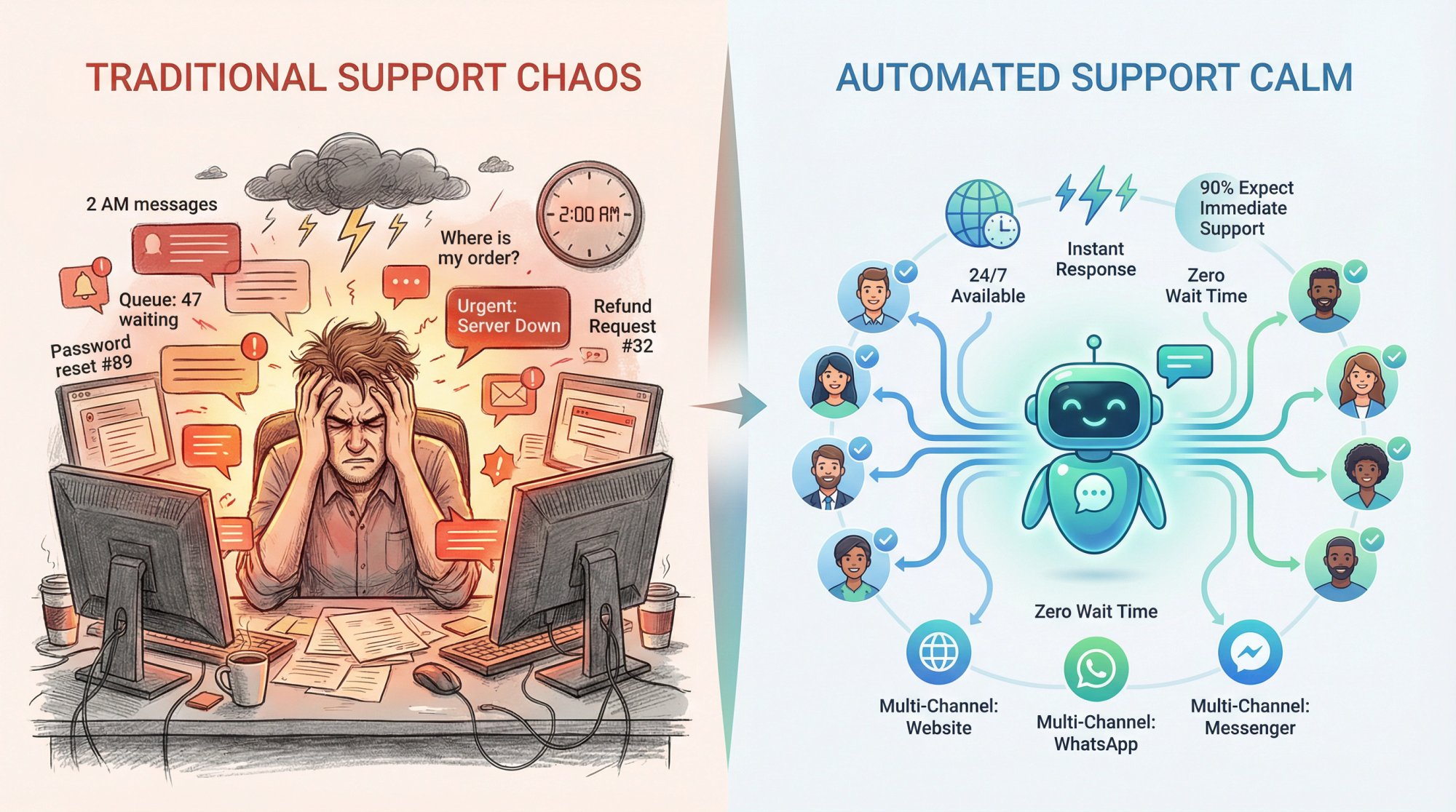
Your support team is drowning in repetitive questions. Same inquiries about shipping. Same password resets. Same "where's my order?" messages flooding in at 2 AM when nobody's awake to answer.
We've seen this pattern thousands of times at Social Intents. Companies pour resources into hiring more agents, extending hours, and still can't keep up with customer expectations. The problem isn't your team. It's that modern customer service demands have outpaced what any human-only approach can sustainably deliver.
Automated customer service solves this. Not by replacing your team, but by handling the repetitive work so your agents can focus on what actually requires human judgment. It's become the difference between scaling your support operation and watching it collapse under its own weight.
| What customers expect | What traditional support delivers | What automation enables |
|---|---|---|
| Immediate responses | Business hours only | 24/7 instant answers |
| Consistent answers | Varies by agent | Same quality every time |
| Multi-channel access | Limited channels | Website, WhatsApp, Messenger, SMS |
| No wait times | Queue delays | Zero queue regardless of volume |
90% of consumers now expect immediate support when they need help (whether from a human or a bot), according to Yellow.ai research. And around 80% of enterprises have already implemented (or are actively planning) customer service automation by 2025.
The advantages are real:
• 24/7 availability
• Instant responses
• Massive cost savings
• Support teams that actually enjoy their work
In this guide, we'll break down exactly why automated customer service works, how it transforms both the customer and agent experience, and what you need to know to implement it effectively in 2025 and beyond.
Why 24/7 Customer Support Matters (And How Automation Delivers It)
Your customers never hit a closed sign.
Traditional support means business hours, time zones, and "We'll get back to you Monday morning" messages. Automated systems handle inquiries at 2:00 AM just as effectively as 2:00 PM. No shifts to schedule, no overtime to pay, no gaps in coverage.
Research from Boost.ai indicates that 50% of customers now expect 24/7 support as standard, especially from global brands. That's not a preference anymore. It's table stakes.
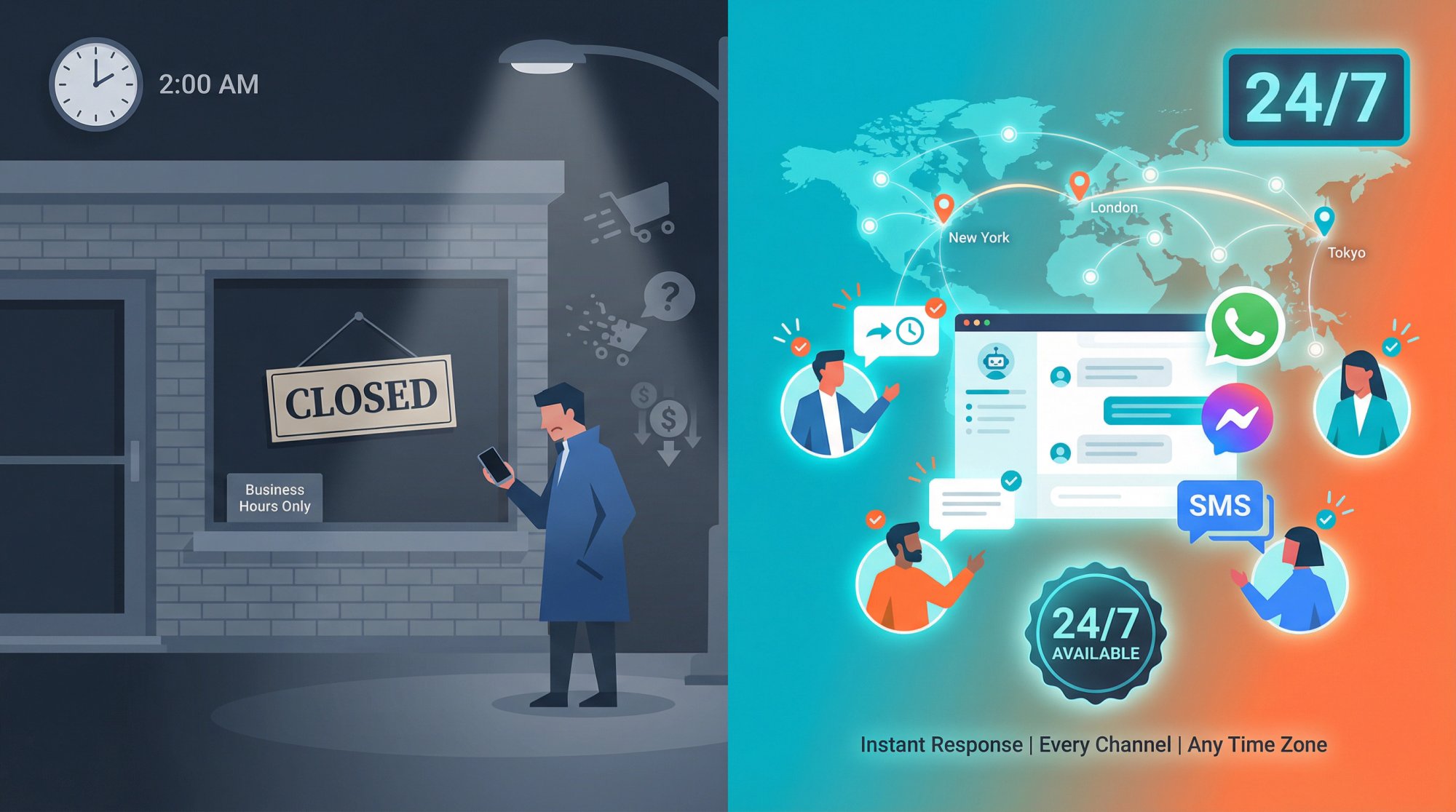
Think about what happens when a customer in Tokyo has a question at midnight Eastern Time. With human-only support, they wait. With automation, they get an instant answer. That inquiry doesn't evaporate. That potential sale doesn't vanish. The conversation happens right when the customer needs it.
This matters for revenue too. Every hour your support is "closed" is an hour you're potentially losing sales, missing escalations, or letting frustrated customers churn to competitors who are available.
How to Provide Omnichannel Support Without Adding Headcount
AI chatbots don't just work around the clock. They work across channels simultaneously.
Whether customers reach out via your website, Facebook Messenger, WhatsApp, or SMS, an automated agent responds immediately. Same quality, same knowledge base, same brand voice.
According to IBM research, chatbot technology enables a true omnichannel approach where you engage users on web, mobile apps, social media, or text messaging with completely consistent experiences.
Meeting customers where they already are builds trust. It signals that your company is reliable, responsive, and actually designed around their needs rather than your convenience.
How to Eliminate Wait Times With Automated Customer Service
Today's customers measure speed in seconds, not minutes or hours.
Nobody wants to sit on hold listening to elevator music. Nobody wants to send an email and wait until "the next business day." Automated customer service delivers instant responses to common questions the moment customers ask them.
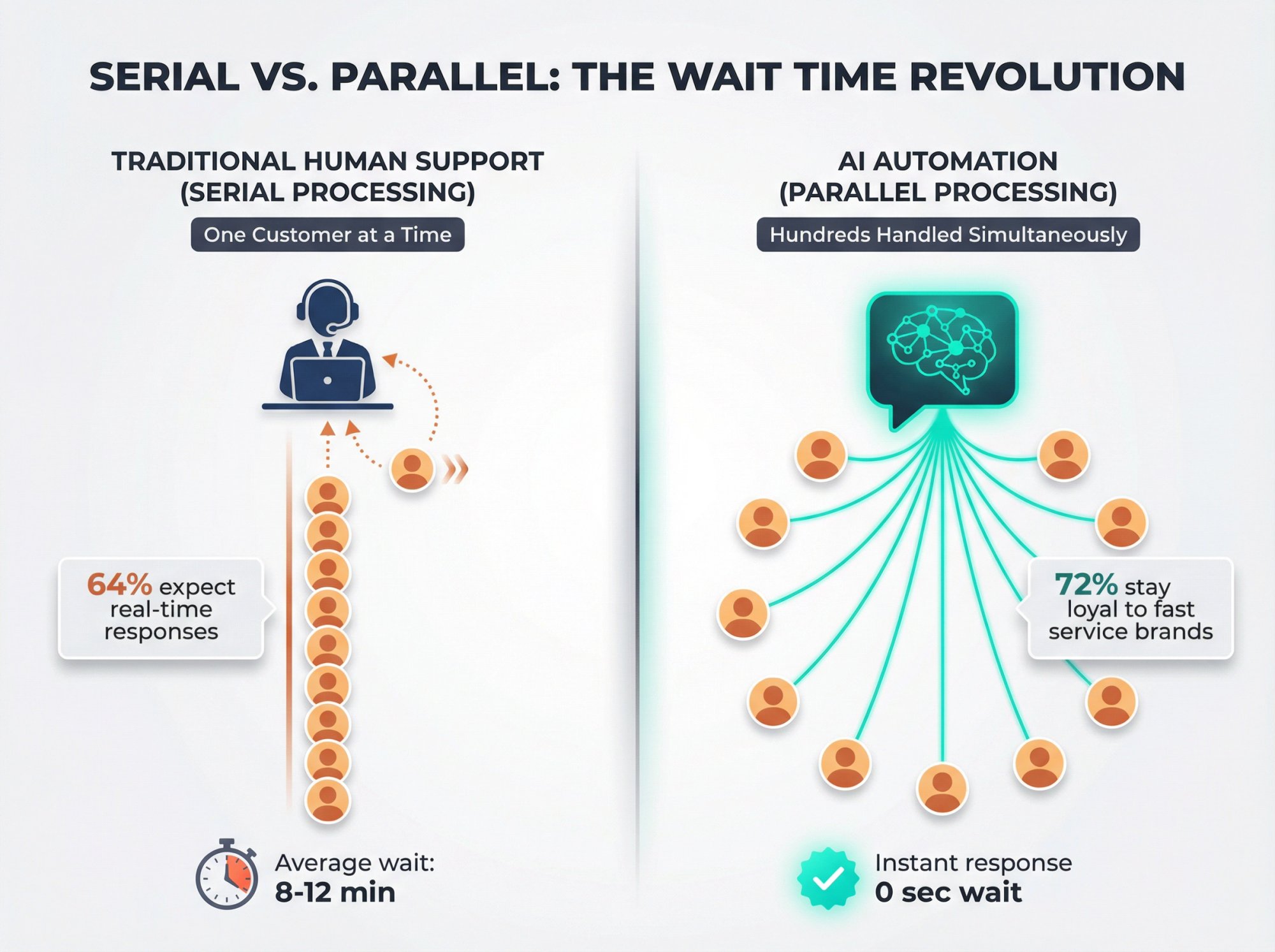
A chatbot can search your knowledge base, pull up order status, reset a password, or provide troubleshooting steps in milliseconds. Salesforce research shows that 64% of consumers expect real-time responses from companies. An AI chatbot that greets users and answers within seconds meets this expectation in ways email or phone queues simply can't match.
Speed directly impacts loyalty.
Studies show that 72% of customers remain loyal to brands that offer fast, convenient service (according to Gorgias data). The faster you resolve issues, the fewer opportunities for frustration to build into negative experiences.
Automation really shines with parallel processing.
While a human agent handles one customer, everyone else waits in a queue. An AI assistant can field hundreds of simultaneous conversations without breaking a sweat. Peak traffic? Holiday rush? Product launch spike? The bot handles it all with virtually zero queue times.
This eliminates the single biggest friction point in traditional support: waiting. When customers get immediate help instead of sitting in line, satisfaction scores climb and abandonment rates plummet.
How to Scale Customer Support During Peak Demand
Traditional support teams hit a wall when volume spikes.
Product launches, Black Friday sales, viral social posts, or sudden PR crises can double (or triple) your support volume overnight. Hiring and training new agents takes weeks. Outsourcing during peaks costs a fortune. Meanwhile, your customers are stuck waiting.
Automated systems scale instantly.
If 1,000 customers ask questions simultaneously, your chatbot engages all 1,000 at once. If 10,000 customers show up, same result. The technology absorbs surge traffic without requiring proportional increases in headcount or infrastructure.
Research from Wizr.ai confirms that automation ensures your customer service quality doesn't suffer as your business grows or faces peak demand.
One e-commerce team reported resolving 27% more support tickets with just two AI-assisted agents (via Gorgias data). Another company nearly doubled their support capacity using AI tools.
For growing companies, this is transformative.
A small team can suddenly punch way above its weight. Startups can provide enterprise-level support. Established businesses can expand into new markets or time zones without matching increases in support staff.
IBM notes that chatbots offer "fast scalability," handling multiple conversations simultaneously as your customer base grows, without matching cost increases.
| Challenge | Traditional Support | Automated Support |
|---|---|---|
| Volume spikes | Linear scaling (more volume = more agents) | Handles surges without added headcount |
| Speed to scale | Weeks to hire/train during spikes | Instant capacity expansion |
| Peak performance | Queue times increase during peaks | Zero queue time regardless of volume |
| Geographic reach | Expansion requires new teams | Serve any timezone without new staff |
How Much Does Automated Customer Service Save in Support Costs?
The cost savings are substantial.
Automation allows companies to deliver quality support at a fraction of the cost of an all-human team. The savings materialize in several ways.
How to Reduce Labor Costs With Automation
Every routine inquiry a bot handles is one fewer a paid agent has to spend time on. Over time, this means handling more customers without proportional increases in headcount and salaries.
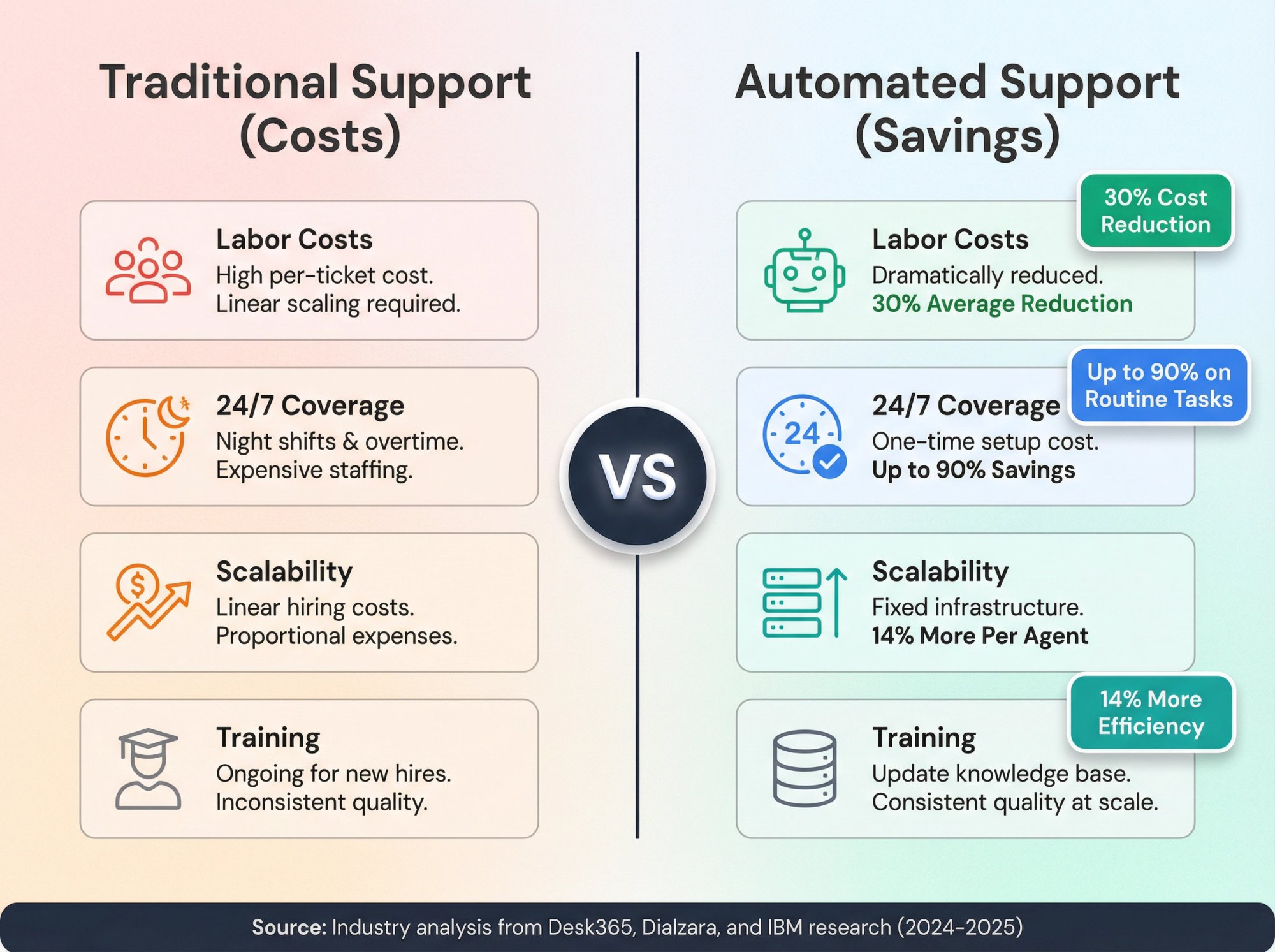
Industry analysis from Desk365 shows that organizations using AI for customer service have seen operational support costs drop by about 30% on average. Some companies report even bigger savings on specific tasks. For example, automating FAQs and order tracking can reduce labor requirements by up to 90% for those particular workflows (according to Dialzara research).
How to Eliminate 24/7 Staffing Costs
Providing true 24/7 human coverage means paying for night shifts, weekends, holidays, and potentially outsourcing. It's expensive.
Chatbots provide after-hours coverage at a fraction of the cost. You eliminate or drastically reduce overtime, shift differentials, and "on-call" expenses.
Real-world example: IBM deployed AI tools to automate parts of their support workflow (like call summaries and ticket routing) and saw a 30% reduction in support operating costs, saving over $5 million annually. Not a small company, but the principle scales down to businesses of any size.
How AI Increases Agent Productivity
Even when human agents are needed, AI can assist by pre-filling customer information, routing requests to the right department, or suggesting answers based on the conversation. This means agents resolve tickets faster and handle more per day.
Support teams using AI assistance report handling about 14% more inquiries per hour without additional staffing. Those efficiency gains translate directly to cost savings (fewer agents needed for the same workload) or the ability to serve more customers with the same team size.
| Cost Category | Traditional Approach | With Automation | Typical Savings |
|---|---|---|---|
| Labor costs | High per-ticket cost | Dramatically reduced | 30% average reduction |
| 24/7 coverage | Night shifts, overtime pay | One-time setup cost | Up to 90% on routine tasks |
| Scalability | Linear hiring costs | Fixed infrastructure | 14% more tickets per agent |
| Training | Ongoing for new hires | Update knowledge base | Consistent quality at scale |
The bottom line: automation lets your support operation do more with less.
You save on hiring, training, and salaries without sacrificing service quality. Those savings can be reallocated to other parts of the business or passed to customers through better pricing.
These efficiencies scale as you grow. You don't face linear growth in costs to support a growing user base. Research confirms that reducing support costs is the top reason business leaders invest in AI and automation (according to Pylon research and Salesmate data).
When done right, automated customer service is a win-win: lower expenses for the company and faster service for the customer.
Why Automated Responses Are More Consistent Than Human Agents
Human agents have off days. They misunderstand questions, provide slightly different answers based on their training or mood, and occasionally make mistakes (we all do).
Automated systems don't.
A major advantage of automation is absolute consistency. Automated customer service follows predefined workflows, uses a centralized knowledge base, and delivers answers based on the same information every single time. This creates more uniform, reliable service quality across all interactions (as noted by Wizr.ai).
For customers, consistency builds trust. They know that asking the same question today or next week will yield the same correct answer. There's no variability based on which agent picks up the chat.
Automation virtually eliminates human error in routine queries.
A bot won't mistype a discount code, miscalculate a refund amount, or forget to follow up. It pulls data correctly from your systems every time. As the team at Social Intents points out, chatbots are programmed to give consistent and accurate responses every time, reducing the miscommunications that can occur with human agents.
This is especially valuable for knowledge-based questions like product specifications, policy details, or compliance information. The automated system ensures the information given is always up-to-date and aligned with your guidelines.
How to Deliver Consistent Service Across All Channels
If your automation runs on web chat, phone IVR, and social media, it delivers the same level of service everywhere. Same rules, same database, same answers.
This omnichannel consistency means customers get a seamless experience no matter how they contact you (according to Wizr.ai research). There's no risk of, say, a phone agent making a promise that contradicts what the chatbot said earlier.
How Automation Enforces Support Best Practices
Automation can be programmed to always greet customers politely, always walk through troubleshooting steps in order, and always log interactions properly. These little things can slip through cracks with busy human agents, but automated workflows ensure nothing gets forgotten.
In industries where accuracy is critical (banking, healthcare, insurance), this reliability becomes a huge benefit. It reduces mistakes that could lead to customer dissatisfaction, compliance violations, or even legal issues.
By minimizing errors and variance, automated customer service helps safeguard your brand's reputation for quality support.
How Automation Increases Customer Satisfaction Scores
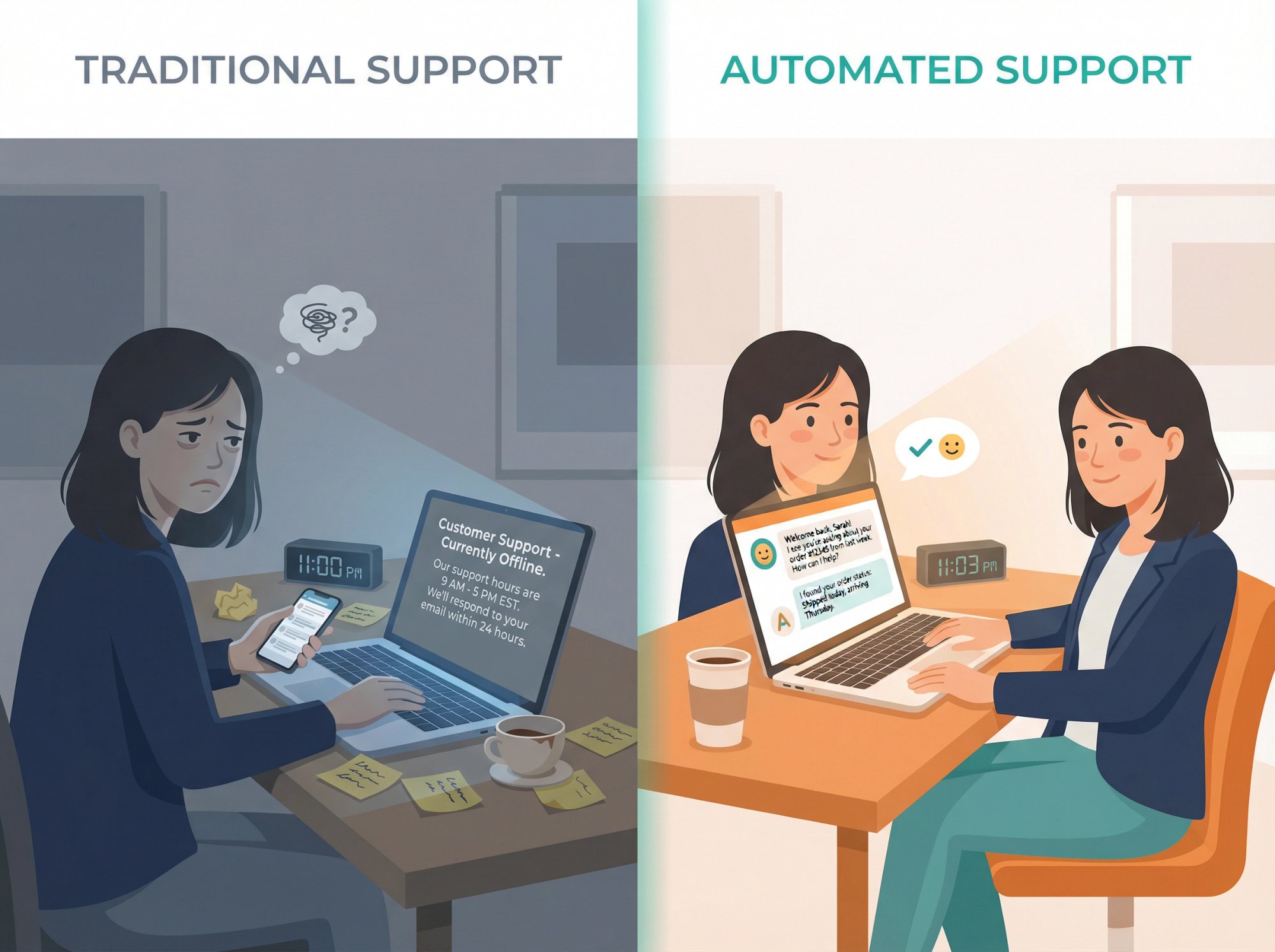
When you combine instant 24/7 help, faster resolutions, and consistent answers, the result is clear: customer satisfaction improves with well-implemented automation.
Modern consumers value service that's quick, convenient, and frictionless. Automation delivers on all three.
Many customers actually prefer interacting with a smart bot for simple issues because it spares them the effort of calling or waiting for email responses. Recent surveys show that 67% of consumers worldwide reported using a chatbot for customer support in the past year (via Social Intents data). That's not a niche behavior anymore. It's mainstream.
Why Instant Acknowledgment Improves Customer Experience
A key element of satisfaction is feeling heard and helped immediately.
A chatbot's ability to instantly acknowledge a query and start solving it makes customers feel taken care of from the first moment. There's no "Your call is important to us, please hold" limbo. The help is already in progress.
This immediacy can turn potentially frustrating situations into positive ones. If a customer can reset their password through an automated chat in one minute at midnight, they're relieved and satisfied. Waiting until the next morning for a response would leave them annoyed (or churned).
Multiple studies confirm that customer satisfaction scores (CSAT) tend to be higher for interactions handled quickly via automation, and speedy service directly drives loyalty (per Gorgias data).
How to Personalize Automated Customer Service at Scale
There's a misconception that "automation equals impersonal service." The reality is quite the opposite when AI is involved.
Modern chatbots can use customer data and context to tailor responses. An AI chatbot integrated with your CRM can recognize a returning customer and greet them by name: "Welcome back, Sarah! Are you asking about order #12345 from last week?"
It can use purchase history to recommend relevant products or proactively offer help based on browsing behavior. According to Zendesk surveys, 70% believe today's chatbots are becoming adept at crafting personalized customer journeys.
Personalization drives loyalty.
Research from Segment found that 60% of consumers would be more loyal to brands that remember their preferences and tailor experiences accordingly.
How AI Chatbots Prevent Customer Frustration
AI systems can also monitor sentiment in real time and escalate to a human agent if they detect frustration or anger. This proactive quality control prevents bad experiences before they spiral.
Also, automation reduces how many times customers have to repeat themselves. When a chatbot collects information and hands off to a human, all that context gets passed along. The customer doesn't have to re-explain their issue. This smooth handoff design keeps customers happier and demonstrates that your company values their time.
In short: automated customer service, when implemented thoughtfully, tends to increase overall satisfaction. It delivers the fast, always-available help people want in a consistent and often personalized manner.
Happy customers become repeat customers and loyal advocates. The advantage isn't just meeting expectations. It's truly differentiating your customer experience from competitors who are slower to help.
Why Automation Makes Support Teams Happier (Not Unemployed)
An advantage most teams discover: your human support agents benefit too.
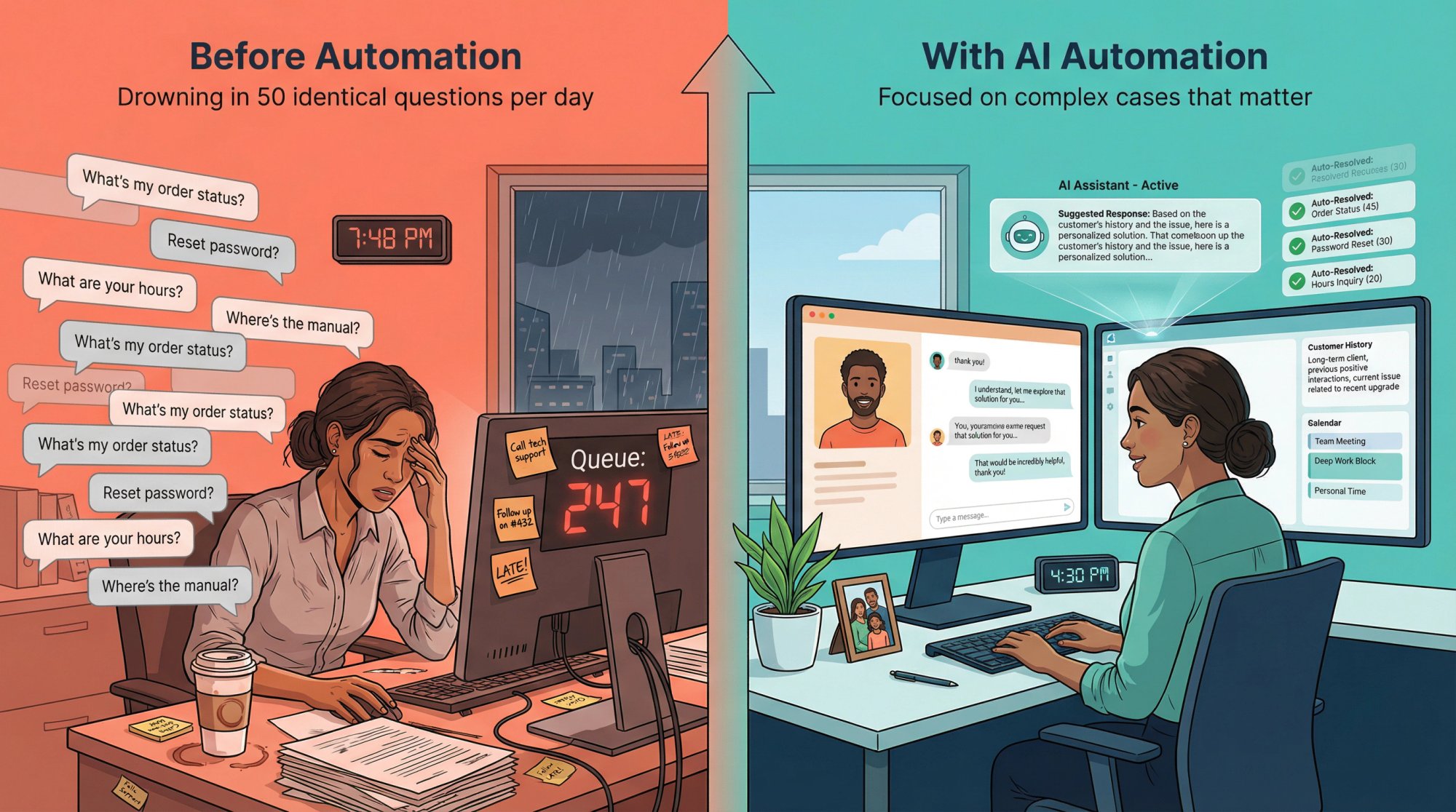
Automation takes over the mundane, repetitive tasks that lead to agent burnout, freeing your staff to focus on meaningful work. When done right, adding chatbots actually empowers your agents and makes their jobs more rewarding.
Think about a typical support workload. A huge portion of tickets are simple, repetitive queries:
→ "What's my order status?"
→ "How do I reset my password?"
→ "What are your hours?"
→ "Where do I find the user manual?"
Answering the same question 50 times a day drains anyone's morale. By offloading these FAQs and routine tasks to chatbots, you lighten the load on human agents. They no longer spend hours on autopilot responses.
Instead, they can focus on complex, high-value cases that truly require human empathy, creativity, and problem-solving: angry customers, nuanced issues, special exceptions, strategic partnerships. As Social Intents notes, automated chatbots don't just save time for customers. They free up human agents to tackle the issues that genuinely require their expertise.
How Automation Reduces Agent Burnout
The impact on agents is twofold. First, it reduces stress and fatigue. They're not swamped by high volumes of trivial tickets, so the overall queue feels manageable. Second, it increases job satisfaction. Agents get to work on challenges that use their skills: creative problem-solving, building customer relationships, handling sensitive situations with empathy. They're not copy-pasting the same answer all day.
Industry reports from Boost.ai confirm that when simple tasks are automated, agent workloads decrease and job satisfaction improves, since staff can engage where their initiative adds the most value.
This also leads to lower turnover. When agents feel valued and aren't burned out, they stay longer. That saves your company money on recruiting and onboarding, and it preserves institutional knowledge.
How AI Agent-Assist Tools Help Human Agents
Automation doesn't just handle customer-facing tasks. It can actively assist human agents in real time.
Agent-assist tools listen to live calls or chats and provide agents with real-time suggestions, knowledge base articles, or even draft replies. This helps agents resolve issues faster and more accurately. Zendesk research shows that AI tools can evolve agent roles into "managers and editors" of AI, letting the AI handle rote tasks while humans ensure quality and handle exceptions.
Agents often appreciate this collaboration. It means less drudgery and more focus on interactions where they truly add value.
Why Automated Triage Leads to Better Agent Interactions
By improving customer satisfaction (through fast automated responses), automation also means agents deal with fewer irate customers daily. Quick automated answers prevent frustration from building. When cases do reach human agents, customers are often in better moods because the bot already acknowledged their issue or solved part of it.
In short, automation creates a more positive environment for your support team. Happier agents deliver better service. It's a virtuous cycle.
How Automated Customer Service Provides Better Business Insights
Every customer interaction is a goldmine of data: questions asked, problems encountered, resolution paths, sentiment, and more.
Automated systems automatically capture and analyze these interactions, providing businesses with valuable insights that drive continuous improvement.
Unlike human-based service (where knowledge often walks out the door when the call ends), automated interactions are digitally logged and can be aggregated for analysis at scale.
How to Use Chatbot Data to Identify Customer Pain Points
Your chatbot transcripts and logs can reveal frequent pain points or trending issues.
If 500 customers this month asked how to integrate your product with Windows 11, you've got a clear signal to publish a help article or improve that feature. AI can identify patterns that aren't obvious at a glance: a spike in questions about an error message after a software update, increasing inquiries from a new market segment, or confusion around a specific policy.
AI-powered support solutions can sift through volumes of customer queries to identify patterns in customer needs and preferences, enabling more proactive and personalized support (according to Boost.ai). These insights help you stay ahead of customer expectations and fix problems before they escalate.
How to Track Support Performance Metrics in Real Time
The data from automated systems helps measure performance.
You can track metrics like resolution time, common topics, bot success rate (how often the bot solved the issue versus needing human escalation), customer satisfaction scores after bot interactions, and more.
These metrics can be monitored in real time via dashboards, giving support managers a clear view of operational health. If the data shows the bot successfully handles 85% of password resets but struggles with the remaining 15%, you can investigate and retrain the bot on those edge cases.
This continuous optimization loop is a huge advantage. It's much easier to refine an AI system over time (just update the knowledge base or dialog flows) than to retrain dozens of human agents consistently.
How Support Data Informs Product Development
Data insights from automation don't just apply to customer service. They can inform broader business strategy.
If the chatbot gets lots of pre-purchase questions about a product's compatibility with certain systems, that's a hint for your marketing team to clarify that information upfront. If customers frequently ask for a feature your product lacks, that data feeds into your product roadmap.
In essence, automated customer interactions serve as a continuous customer research channel. Traditional support might capture some of this anecdotally, but automation quantifies it at scale.
How AI Systems Get Smarter Over Time
The data an AI system collects can even be used to train better AI models for the future.
Over time, as your chatbot handles more conversations, it leverages machine learning to improve its own understanding and responses. AI chatbots learn from new situations and continuously get smarter (as noted by Social Intents). This means your automated service gets more effective the more it's used, creating a virtuous cycle of improvement.
Companies that tap into these analytics can continuously refine both their customer service and their products to better meet customer needs.
How to Turn Customer Support Into a Revenue Channel
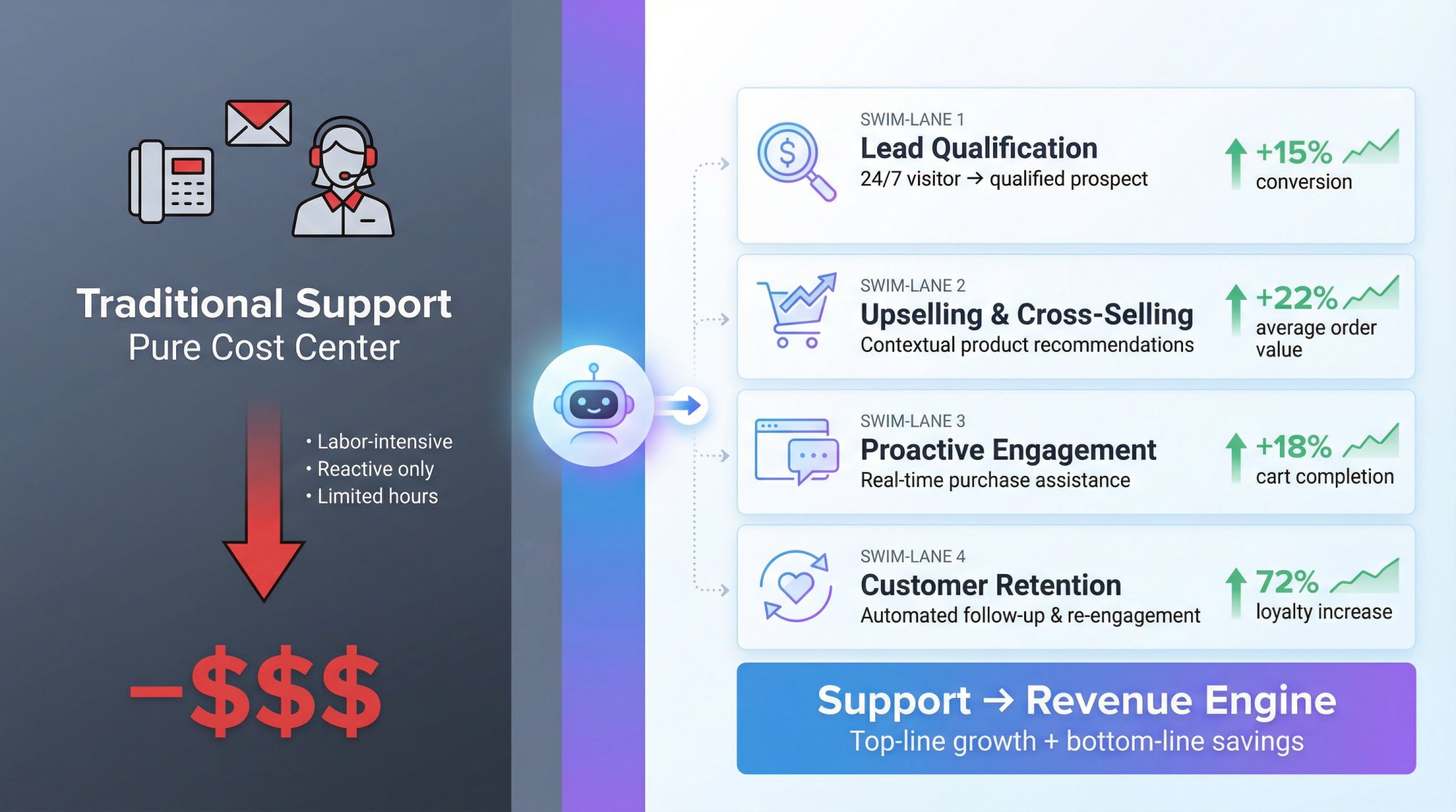
While customer service automation is primarily about support, it has a powerful side benefit: boosting sales and revenue opportunities.
An automated service tool like a chatbot can double as a marketing and sales assistant, not just a support rep. This advantage turns your support channel from a pure cost center into a potential profit driver.
How to Qualify Leads Automatically With Chatbots
A chatbot on your website can greet visitors and ask qualifying questions in a friendly, automated dialog.
It can collect the visitor's name, email, needs, and intelligently figure out if they're a potential customer. For example, a Social Intents chatbot can ask, "Hi there! Are you looking for product information or support today?" If the user indicates interest in a product, the bot gathers their details and seamlessly hands them to the sales team.
This automated lead qualification ensures your sales reps spend time on hot prospects, not chasing every inquiry blindly. As Social Intents notes, lead generation chatbots can qualify prospects and route serious buyers to your sales team, helping you focus on the leads that really matter.
The result? Higher conversion rates. You're essentially adding a 24/7 sales development rep that engages every website visitor instantly.
How Chatbots Increase Sales Through Upselling
Chatbots can perform upselling and cross-selling during support interactions.
If a customer asks about a problem that a premium feature could solve, the bot can suggest it. For instance, if a customer asks how to get faster internet speeds, the bot might recommend a higher-tier plan.
These suggestions can be contextual and helpful, so they don't come across as pushy sales tactics. IBM research shows that AI chatbots are effective at encouraging conversions by speeding up response times, guiding customers toward purchases, and handing over to human sales agents for complex deals when needed.
In e-commerce, bots can remind users about items in their cart, offer promotions, or recommend complementary products ("Customers who bought X often buy Y"). All of this gently nudges customers along the buying journey.
How Proactive Chat Popups Increase Conversions
Automated systems can trigger messages to users who might need help deciding.
For example, if someone has been browsing a pricing page for a while, a chatbot can pop up and say, "Let me know if you have any questions about our plans or want a recommendation." This often prompts users to engage and can clarify doubts that would otherwise prevent a sale.
Research has shown that real-time engagement like this can significantly increase conversion rates by addressing questions at the critical moment. The bot plays the role of an attentive salesperson who notices a hesitant customer and offers assistance.
How Automated Follow-Up Increases Customer Lifetime Value
Automation also helps with re-engagement and loyalty.
Chatbots can send follow-up messages checking if a recent issue was resolved satisfactorily, or informing customers about new features relevant to past inquiries. By keeping customers engaged and informed, you increase their lifetime value.
Satisfied customers buy more over time and refer others. As we've seen, 72% of customers remain loyal to brands that offer fast support experiences (according to Gorgias data). That loyalty translates to repeat purchases and positive word-of-mouth.
In summary: automated customer service doesn't just save money. It helps make money. By capturing leads around the clock, assisting customers in purchase decisions, and enhancing overall satisfaction (which drives retention), automation contributes to top-line growth.
It's an often underrated advantage: your customer service chatbot might just become one of your best sales assistants.
How Social Intents Makes Automated Customer Service Easy
If you're ready to implement automated customer service but worried about complexity, Social Intents offers a streamlined solution designed specifically for teams that want powerful automation without the hassle.
Social Intents delivers:
Live Chat and AI Chatbots in One Platform
Social Intents combines live chat with AI-powered chatbots in a single, integrated platform. You get the best of both worlds: instant automated responses for routine questions, with seamless handoff to human agents for complex issues.
The AI chatbots can be trained on your website content, documents, and knowledge bases in minutes. Powered by leading AI models (OpenAI ChatGPT, Anthropic Claude, Google Gemini), they deliver accurate, contextual answers. When the bot encounters a question it can't handle, it escalates smoothly to your human team.
Answer From the Tools You Already Use
One of the biggest advantages of Social Intents is that your team answers chats directly from Microsoft Teams, Slack, Google Chat, Zoom, or Webex. There's no new interface to learn, no separate dashboard to monitor.
Your support staff stays in the collaboration tools they already use all day. When a customer starts a chat on your website, it appears as a message in your Teams channel or Slack workspace. Your agents reply right there, and the customer sees the response instantly on your site.
This eliminates the friction of training agents on yet another platform and dramatically speeds up adoption.
Unlimited Agents (Starting at the Basic Tier)
Most live chat platforms charge per agent, which gets expensive fast. Social Intents offers unlimited agents starting from the Basic plan at just $69/month (billed annually).
Whether you have 3 agents or 30, your cost stays the same. This makes it incredibly cost-effective for growing teams and removes the penalty for giving more people access.
Fast Setup for Shopify, WordPress, BigCommerce, and More
Social Intents integrates natively with Shopify, BigCommerce, Wix, WordPress, and Webflow. If you run an e-commerce store or use any of these platforms, you can have live chat and AI automation running on your site in minutes, not days.
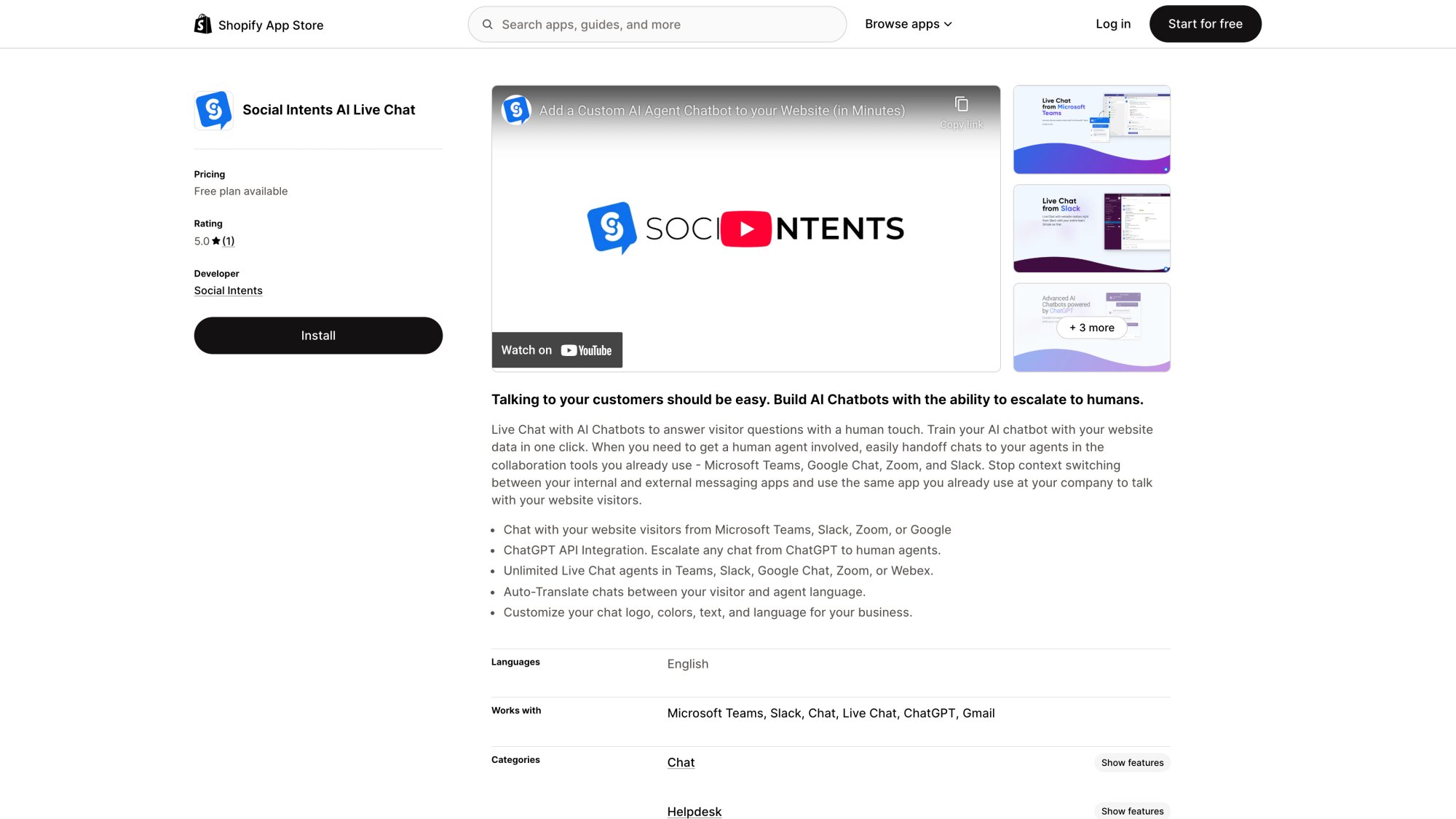
There are also Zapier integrations for automating workflows like pushing transcripts to your CRM, creating tickets, or triggering follow-up emails.
Custom AI Actions for Advanced Automation
Need to check order status, create support tickets, or pull shipping information during a chat? Social Intents supports Custom AI Actions, which are integrations with third-party tools that enrich chat conversations.
These custom actions let your chatbot do things like look up account details, update records, or trigger specific workflows. This capability is getting significant attention from businesses that want to truly automate complex support scenarios.
WhatsApp and Messenger Chatbots
Beyond your website, Social Intents also lets you create AI chatbots for WhatsApp and Facebook Messenger. This extends your automated support to the channels where your customers already spend time, with the same seamless escalation to human agents when needed.
Transparent Pricing That Scales With You
Social Intents offers straightforward pricing with four main tiers (Starter, Basic, Pro, Business) plus an Agency/Reseller plan:
| Plan | Price (Annual) | Key Features |
|---|---|---|
| Starter | $39/mo | 1 widget, 3 agents, 200 conversations/month, ChatGPT integration |
| Basic | $69/mo | 2 widgets, unlimited agents, 1,000 conversations/month |
| Pro | $99/mo | 5 widgets, unlimited agents, 5,000 conversations/month, remove co-branding |
| Business | $199/mo | 10 widgets, unlimited agents, 10,000 conversations/month, real-time auto-translation |
All plans include a 14-day free trial, so you can test the platform risk-free.
White-Label Solution for Agencies
If you're an agency or web design provider looking to offer live chat and AI chatbots as part of your service, Social Intents has an Agency/Reseller plan at $299/month. This includes 20 chatbots, white-label branding, sub-accounts, and a brandable portal.
This plan has been gaining significant traction as agencies and Microsoft partners look to enhance their offerings with AI-powered chat capabilities.
Get Started in Minutes
Ready to see the advantages of automated customer service in action? Sign up for a free 14-day trial and experience how Social Intents can transform your support operation.
Whether you're a small team looking to scale or an enterprise wanting to reduce costs while improving satisfaction, Social Intents provides the tools you need to deliver exceptional automated customer service.
Frequently Asked Questions
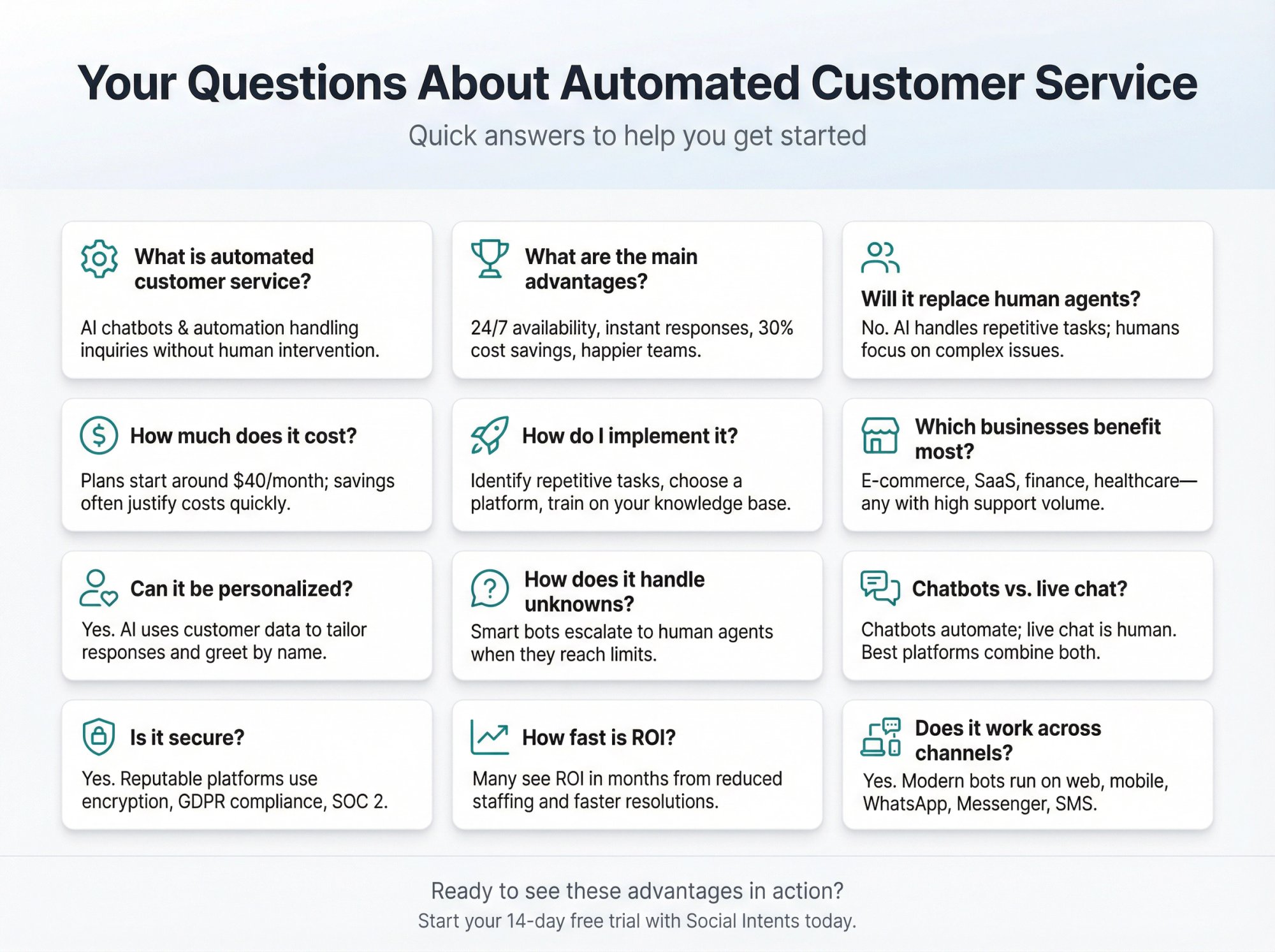
What is automated customer service?
Automated customer service uses AI chatbots, self-service portals, and workflow automation to handle customer inquiries without human intervention. These systems can answer questions, solve problems, route requests, and escalate complex issues to human agents when needed. The goal is to provide faster, more efficient support while reducing the workload on human teams.
What are the main advantages of automated customer service?
The key advantages include:
① 24/7 availability without overtime costs
② Instant responses (no wait times)
③ Effortless scalability during peak demand
④ Significant cost savings (up to 30% reduction)
⑤ Consistent, accurate answers every time
⑥ Higher customer satisfaction through speed and convenience
⑦ Happier support teams (eliminating repetitive work)
⑧ Valuable data insights for continuous improvement
⑨ Increased sales opportunities through lead generation and upselling
Will automated customer service replace human agents?
No. The best customer experiences come from blending AI automation with human empathy. Automation handles routine, repetitive queries (password resets, order status, FAQs), freeing human agents to focus on complex issues that require creativity, empathy, and nuanced problem-solving. Think of automation as augmenting your team, not replacing it.
How much does automated customer service cost?
Costs vary widely based on the platform and features you need. Many chatbot platforms offer plans starting around $40-$100/month for small businesses. Social Intents, for example, offers plans starting at $39/month with unlimited agents from the Basic tier upward ($69/month). Enterprise solutions can run into thousands per month but often deliver proportional savings through reduced support staff requirements.
How do I implement automated customer service?
Start by identifying high-volume, repetitive support tasks that automation can handle (FAQs, order tracking, basic troubleshooting). Choose a platform that integrates with your existing tools. Social Intents works directly with Teams, Slack, Google Chat, Zoom, and Webex, which simplifies adoption. Train your chatbot on your knowledge base, test thoroughly, and launch with clear escalation paths to human agents when needed.
What types of businesses benefit most from automation?
Any business with high support volumes benefits, but it's especially valuable for:
→ E-commerce stores handling order inquiries and product questions (see our Shopify and BigCommerce integrations)
→ SaaS companies providing technical support and onboarding
→ Financial services answering account and policy questions
→ Healthcare managing appointment scheduling and basic patient inquiries
→ Agencies offering white-label support to multiple clients (see our Agency plan)
Essentially, if your team spends significant time answering the same questions repeatedly, automation will help.
Can automated customer service be personalized?
Absolutely. Modern AI chatbots can use customer data and context to tailor responses. They can recognize returning customers, greet them by name, reference past orders or interactions, and make relevant product recommendations. Research from Zendesk shows that 70% of CX leaders believe today's chatbots are becoming adept at crafting personalized customer journeys. When integrated with your CRM, automation can deliver highly personalized experiences at scale.
How do chatbots handle questions they don't know?
Well-designed chatbots are programmed to recognize when they've reached their limits and escalate to human agents. For example, if a customer asks a question the bot hasn't been trained on, it can say, "I'm not sure about that. Let me connect you with someone who can help." This ensures customers never get stuck in frustrating loops with an unhelpful bot.
What's the difference between chatbots and live chat?
Live chat is a real-time messaging channel where human agents communicate with customers. Chatbots are AI-powered assistants that automate responses. The best solutions (like Social Intents) combine both: chatbots handle routine queries instantly, and complex issues escalate seamlessly to human agents via live chat.
Is automated customer service secure?
Reputable platforms use encryption for data in transit and at rest, follow industry security standards, and offer compliance options like GDPR and DPA agreements. When evaluating platforms, ask about their security practices, certifications (SOC 2, ISO 27001), and data retention policies. Social Intents, for instance, uses AWS hosting with encryption and offers GDPR compliance and DPA agreements.
How quickly can I see ROI from automated customer service?
Many businesses see ROI within the first few months. Cost savings from reduced staffing requirements, faster resolution times, and improved efficiency often outweigh platform costs quickly. Also, the revenue impact from capturing leads 24/7, improving customer satisfaction, and reducing churn can accelerate ROI. Companies typically report 30% lower support costs and 40% faster response times on average after implementing automation (according to Wizr.ai data).
Can automation work across multiple channels?
Yes. Modern chatbot platforms support omnichannel deployment, meaning you can run the same bot on your website, mobile app, Facebook Messenger, WhatsApp, and SMS. Social Intents, for example, supports website chat, WhatsApp chatbots, and Messenger chatbots, all from a single platform. This ensures consistent service quality regardless of how customers reach out.